Listening guide
Albanian iso-polyphony explained
How Albanian iso-polyphony works: the solo voices, the held drone called iso, the north and south of the tradition, and what UNESCO says about it.
Hold a place at the show ↗What it is
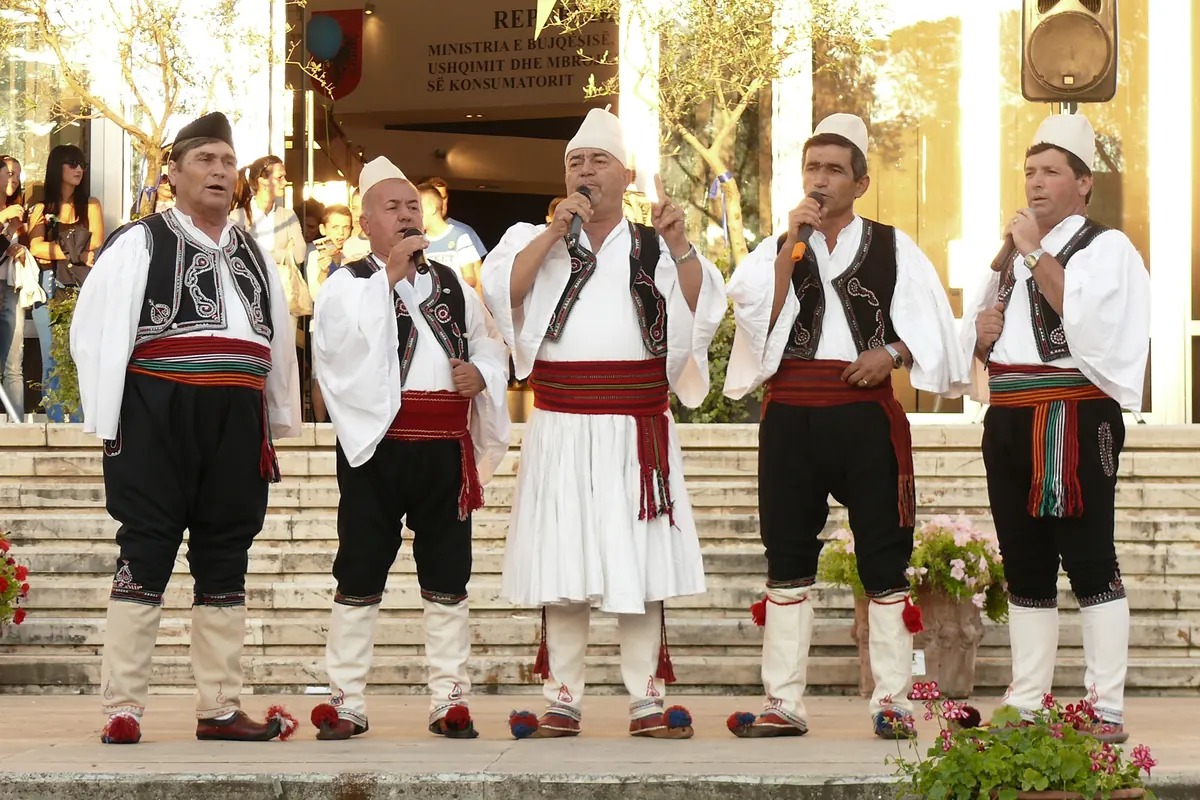
Iso-polyphony is Albanian folk singing in several lines at once, with a choir holding a drone underneath. Wikipedia describes it as multi-line singing with choral drone parts and many regional variants. UNESCO says it is rendered mainly by male singers and accompanies weddings, funerals, harvest feasts, religious celebrations and festivals, among them the folk festival in Gjirokastër. That range matters for listeners: the same musical grammar serves both joy and grief, so a song's mood comes from the words and the delivery, not from the form.
The voices
UNESCO describes songs made of two solo parts, a melody and a countermelody, over a choral drone. Wikipedia gives the traditional names: the marrës, the first voice or taker, begins; the kthyes or pritës, the turner, answers; and in some southern regions a third solo voice, the hedhës or launcher, adds a layer that makes four-part singing. Four-voice singing is described as a specialty of Labëria. When you listen, try to follow the first voice, then the answer, and treat the rest as a weave around them.
The drone called iso
The word iso gives the tradition its name. UNESCO says it is related to the ison of Byzantine church music, the drone that accompanies the chant. Among the Tosks of the south, the drone is continuous and sung on the syllable e, with singers staggering their breathing so the note never stops. Among the Labs it is sometimes sung as a rhythmic tone to the words of the song. Wikipedia adds that varieties without a drone are rare today, and that singers call out phrases like Béni iso, meaning make the drone.
North and south
UNESCO divides Albanian folk singing into two broad stylistic groups: the Ghegs of the north and the Tosks and Labs of the south. The best-known polyphony belongs to the south. Wikipedia lists four southern regions with their own styles, Lalëria or Myzeqe, Toskëria, Çamëria and Labëria, and mentions a related form in northern areas such as Peshkopi and Malësia. One style, pleqërishte, is sung by men in Labëria around Gjirokastër and is marked by a slow tempo, low pitch and small range.
How old is it?
Nobody can date it exactly. Wikipedia says the roots may lie in the many-voiced vajtim, a southern lament for the dead, and that many scholars place the tradition in the Thraco-Illyrian era, citing features such as its pentatonic structure and its calls and shouts. That is an argument from musical evidence, not a documented history, so treat the claim of great antiquity as a theory. What is documented is the fieldwork and the festival record: the Gjirokastër National Folklore Festival has featured polyphonic songs since 1968.
A tradition under pressure
UNESCO proclaimed Albanian folk iso-polyphony in 2005 and inscribed it on its Representative List in 2008. The same entry warns of threats: poverty, a lack of legal protection and financial support, and migration of young people from villages to cities and abroad. Transmission, it says, now relies on professional folk artists rather than on the family. That is part of why a staged evening such as Albanian Night matters, and why it is worth listening for the drone before the solo lines begin.
Hearing it live in Tirana
Tirana's tourism office describes how Albanian Night uses the tradition. In the middle of the staged wedding, the mood changes suddenly and the wedding gives way to a mourning scene sung in polyphony, with no instrument. The office invites listeners to consider why this kind of music became a UNESCO heritage item. Prepare by recognising the three layers described above: the lead voices, the answer, and the drone. You will probably notice the drone last, because it sits under everything, but once you hear it you cannot stop hearing it.
Sources